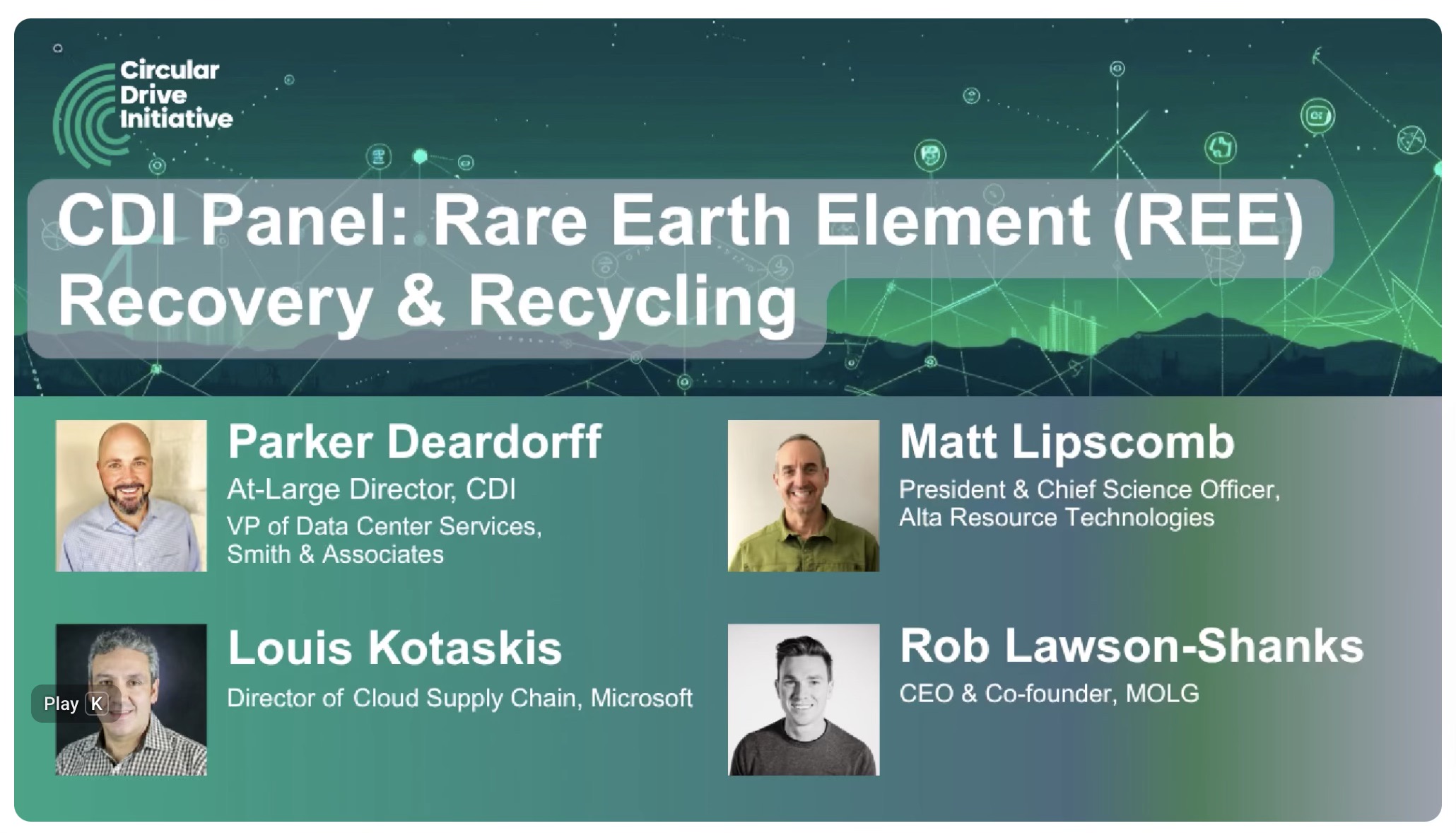
Rare earth elements (REEs) are essential to modern technology but recycling them remains one of the biggest challenges in the path to a circular economy. In this Circular Drive Initiative (CDI) panel discussion, experts from Microsoft, MOLG, and Alta Resource Technologies explored how innovation, collaboration, and new supply chains can help recover and reuse these critical materials.
Building a Circular Supply Chain for Rare Earths
Microsoft’s Louis Kotsakis described how the company’s efforts toward REE recovery began as an internal hackathon project that evolved into a full-scale sustainability initiative.
“We started with an idea to recover magnets from hard drives,” he explained. “We failed at first, but we pivoted quickly, building two channels for recycling and disassembly so we can capture magnets directly and send them downstream for rare earth processing.”
These magnets, which are key components in data center hardware, represent a promising domestic source of REEs. Matt Lipscomb of Alta Resource Technologies noted that while the United States has limited mining potential, “the best available source of heavy rare earths isn’t in the ground, it’s in the magnets we already have.”
Alta has developed a clean, scalable process that separates and purifies individual rare earth elements, making them ready for reuse in new products.
Rob Lawson-Shanks of MOLG added that automation plays a crucial role in bridging the gap between upstream and downstream partners. “We’re focused on how to take things apart efficiently,” he said. “It’s about finding the right level of disassembly so the next players in the chain can extract the most value.”
The Challenges Ahead: Cost, Design, and Collaboration
While the environmental and national security benefits are clear, cost remains one of the largest barriers to widespread REE recovery. Building infrastructure for collection, disassembly, and separation requires significant investment and coordination across multiple industries.
Lipscomb emphasized that it’s not just about having funds available; it’s about having the right type of investment. “Early-stage technologies can run on venture capital,” he said, “but scaling a new supply chain needs patient, strategic investors such as companies like Microsoft that have both a financial and operational interest in making this work.”
Design optimization is another challenge. As Lawson-Shanks noted, future hardware could be built with reuse and recovery in mind, making disassembly faster and less costly. “There’s room for more standardization,” he said. “It’s not about making one product better than another, it’s about making the whole lifecycle more efficient.”
Keeping the Value and the Materials at Home
Today, most shredded hard drives in the U.S. are exported overseas for processing.
“Drives are often sold for less than a dollar a pound and shipped abroad for processing,” explained a CDI member from the audience. “That means we’re effectively exporting valuable materials and depending on foreign supply chains to get them back.” Developing domestic processing capacity will require continued collaboration between hyperscalers, recyclers, and technology innovators.
Collaboration at the Core
Throughout the discussion, all panelists agreed that progress depends on collaboration within CDI and beyond.
“Ideas are easy,” Kotsakis said. “The real challenge is operationalizing them. If we work together and build economies of scale, we can make this the default way of doing business.”
Deardorff closed the session by underscoring CDI’s role as a convening force. By connecting members from across the circular economy—including drive manufacturers, recyclers, ITADs, and technology innovators—the initiative is helping turn sustainability goals into scalable, real-world solutions.
Watch the full discussion: REE Recovery & Recycling Panel on YouTube
Learn more about CDI’s work on circular data storage: www.circulardrives.org