The following example illustrates how industry collaborations are helping address operational barriers to secure reuse and circular IT workflows.
By Kon Maragelis, Blancco
The circular economy depends on more than good intentions—it requires repeatable, auditable processes that make reuse viable at scale. For device disposition, the challenge often comes down to one critical step: secure data sanitization.
For devices like Apple Macs, this disposition step has historically been complex, time-consuming, and difficult to standardize across high-volume environments. Yet as enterprise refresh cycles accelerate and secondary markets grow, solving this bottleneck is essential to advancing Circular Drive Initiative (CDI) goals: reducing e-waste while ensuring trusted, standards-based reuse.
This is especially true as reports show Macs gaining traction in security-conscious enterprises and developer environments, with higher-end devices increasing in both volume and value for secondary markets.
A recent integration between Blancco Technology Group and connectivity innovator Cambrionix offers a compelling example of how the industry is evolving—bringing together certified erasure, automation, and parallel processing to support circularity in practice.
Why Apple Macs present a unique circularity challenge
Apple’s security architecture has strengthened significantly over time, particularly with the introduction of T2 security chips and, more recently, Apple silicon. While these innovations improve data protection for end users, they also introduce new layers of complexity for key industry drivers of device reuse: IT asset disposition (ITAD) providers and in-house IT asset management teams.
Unlike standalone storage devices, Macs must be processed as complete systems and often require:
- Device-specific workflows, including entering recovery or device firmware update (DFU) modes for system-level restoration
- Tightly integrated hardware and software coordination, where storage, operating system, and security functions are interdependent
- Careful handling of firmware and security controls, such as Apple Secure Boot, activation lock, and other protections tied to Apple silicon or T2 architectures
These factors can slow down processing and increase the risk of inconsistencies—two barriers to scalable reuse.
At the same time, Macs retain strong residual value, making them ideal candidates for circular programs—if they can be processed efficiently and compliantly.
From fragmented workflows to integrated processing
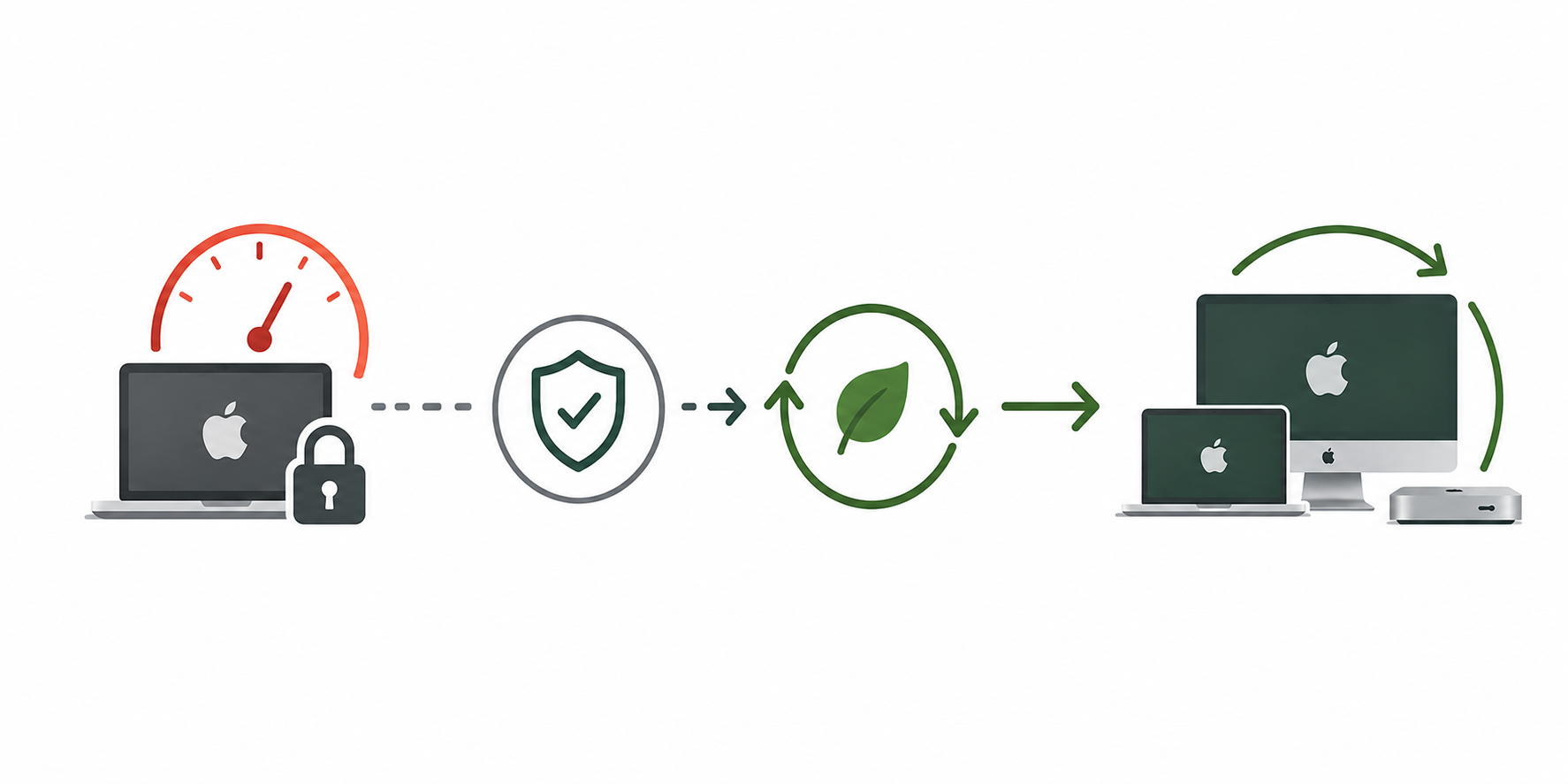
Traditional ITAD workflows often separate erasure, diagnostics, and OS reinstallation into distinct steps. This fragmentation introduces delays, increases handling, and complicates auditability.
Blancco’s approach—reflected in its integration with Cambrionix—focuses on consolidating these steps into a unified workflow:
- Certified data erasure with tamper-proof reporting
- Automated device handling and diagnostics
- Immediate preparation for reimaging and redeployment
By reducing process fragmentation, ITAD providers or enterprise in-house teams can improve both throughput and compliance—two factors that directly influence how quickly devices can be made available to the secondary market or for internal redeployment.
Automating data erasure in alignment with standards like IEEE 2883 helps ensure data is fully and verifiably removed—making it faster and safer to redeploy devices in line with CDI principles of extended device lifecycles.
These factors translate to greater value to ITADs and their enterprise customers, quickly determining whether previously used Macs, if not being redeployed internally, should be resold or recycled. Once determined, sellable devices can then be ushered into the secondary market more quickly.
Scaling circularity through parallelization
One of the most significant barriers to reuse is throughput. If devices cannot be processed quickly enough, their resale value declines—and recycling becomes the default outcome.
Cambrionix addresses this challenge through high-density USB hub technology, enabling multiple Macs to be processed simultaneously. When paired with Blancco’s automation capabilities, this creates a shift from linear workflows to parallel, high-volume operations.
For instance, traditional Mac device firmware updates (DFU) are operator facilitated, machine by machine. By automating this manual process via the Cambrionix industrial USB hub, this bottleneck is removed, allowing multiple devices to be updated all at once. The hub also compresses the amount of workspace needed, optimizing the area needed to process more devices. Together, these two advances dramatically accelerate processing time and significantly affect what service providers can deliver to the circular economy.
In practical terms:
- Dozens of devices can be connected and processed at once
- Manual intervention is minimized
- Processing times are dramatically reduced
- Physical space is optimized, allowing more inventory to be processed in a compressed work area.
This is where circularity becomes operationally viable. This collaboration exceeds the typical rate of processing three to four Mac devices an hour to 48 Macs an hour—an increase of more than 10x even before additional hubs are added.
Faster turnaround means more devices reach secondary markets while still holding value, directly supporting CDI’s mission to extend hardware lifecycles.
Trust as the enabler of reuse
Circularity is ultimately a trust economy. No matter how fast devices can be processed, both downstream users—whether enterprises, resellers, or consumers—and their original owners, need assurance that devices are safe, functional, and compliant—and protected against data leaks.
While Macs still make up a minority of endpoint devices in enterprise fleets, their adoption seems to be growing in security-conscious industries and emerging AI use cases, adding to established popularity within executive, development, and engineering teams. This means they carry not just residual value, but heightened security concerns at end of use.
Within this ecosystem, Blancco focuses on enabling provable, software-based data sanitization for a range of operating systems, including macOS, generating audit-ready reports that demonstrate alignment with industry standards and compliance with data privacy and protection laws from around the world. This is particularly important as regulatory scrutiny around data disposal continues to increase globally.
For Mac sellers and buyers, the peace of mind that comes from knowing that previously stored data is rendered completely and permanently inaccessible by unauthorized users is critical to ongoing market viability.
For CDI stakeholders, this reinforces a key principle: secure data erasure is not just a technical requirement—it’s a market enabler. But without automation, reuse channels cannot grow at scale.
Designing for the next phase of circular IT
The integration between Blancco and Cambrionix highlights this needed shift, moving from manual, fragmented processes to automated, standards-driven systems.
For circularity to scale, three elements must come together:
- Automation to handle increasing device volumes
- Compliance to meet evolving global standards
- Integration to eliminate inefficiencies across workflows
Apple devices, with their strong resale value and growing enterprise footprint, represent a critical test case for this model.
As CDI continues to advance secure reuse across the storage ecosystem, solutions that combine speed, compliance, and scalability will define the next phase of sustainable IT.
Because in a truly circular system, success isn’t measured by how efficiently we recycle—but by how effectively we reuse, redeploy, and extend the life of every device we can trust.